Sciatic Nerve
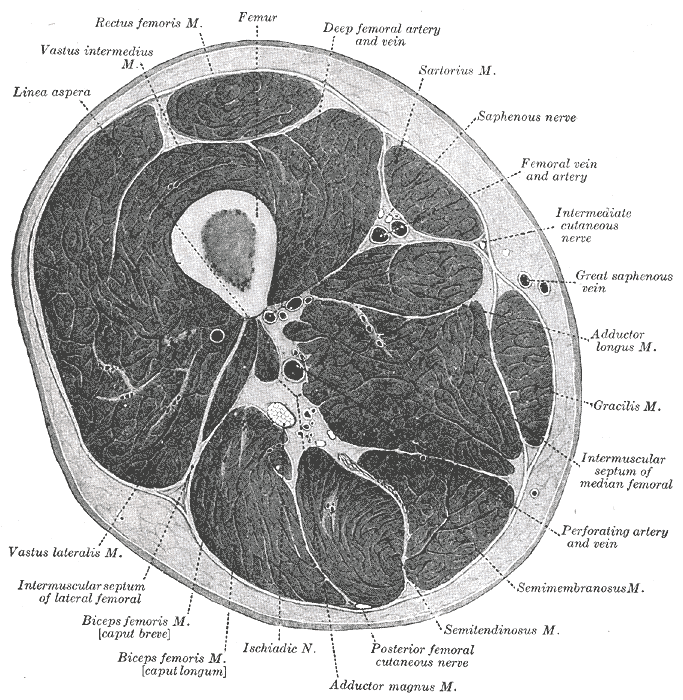
Roots
Pathway
Common Fibular Division
Motor innervation
Direct Branches
| Muscle | Origin | Insertion | Innervation | Action |
|---|---|---|---|---|
| Biceps femoris long head | Ischial tuberosity Sacrotuberous lig. (Common head with semitendinosus) |
Fibular head | Tibial n. L5 - S2 |
Hip: Extension Knee: Flexion, ER Pelvis: Sagittal stabilization |
| Semitendinosus | Ischial tuberosity Sacrotuberous lig. (common head with biceps femoris long head) |
Pes anserine | Tibial n. L5 - S2 |
Hip: Extension Knee: Flexion, IR Pelvis: Sagittal stabilization |
Cutaneous Innervation
Examination
Neural Tension Test
The Active Slump Test applies a neural tension on the Sciatic n. and the L4 and L53
Dysfunction
Damage to the common fibular division during Total hip arthroplasty can result in drop foot
- Deep gluteal syndrome is an increasingly recognized disease entity, caused by compression of the sciatic or pudendal nerve due to non-discogenic pelvic lesions
Entrapment
Treatment
Depending on your school of thought, either the sciatic nerve becomes inflamed and adheres to surrounding muscles making these muscles tight or the muscles become tight and entrap the sciatic nerve. Regardless of the pathological mechanism, the treatment can remain largely the same.
Release the muscles surrounding the sciatic nerve using manual therapy, cupping, stretching, and exercise
- Ankle pumps
- SLR
- Modified deadlift with DF deficit
- Heel raise with DF deficit
References
1.
Gray H. Anatomy of the Human Body. 20th ed. (Lewis WH, ed.). Lea & Febiger; 1918. https://www.bartleby.com/107/
2.
Gilroy AM, MacPherson BR, Wikenheiser JC, Voll MM, Wesker K, Schünke M, eds. Atlas of Anatomy. 4th ed. Thieme; 2020.
3.
APTA. Current Concepts of Orthopaedic Physical Therapy. 5th ed.; 2024.
4.
Kolar P. Clinical Rehabilitation. 1st ed. Dynamic Neurological Stabilization; 2014.
Citation
For attribution, please cite this work as:
Yomogida N, Kerstein C. Sciatic Nerve. https://yomokerst.com/The
Archive/Anatomy/Nerves/Lumbosacral Plexus/Sacral
Plexus/sciatic_nerve.html